
The Right Age to Start Preschool STEM Is Younger Than You’d Guess
Creative world school Sep 8, 2026Somewhere between the toddler coding classes and the forty-dollar science kits, it’s fair to wonder if STEM for little kids has gone too far. The short answer is that your child started a long time ago and nobody signed them up. Babies begin forming ideas about math from the moment they’re born, through ordinary days and the grownups who talk them through it.
So the better question is what early science and math thinking look like at your child’s age right now, because at 2 they look nothing like they do at 5. Get that part right and the worry mostly dissolves. Get it wrong and you end up with a kit built for a 7-year-old, a frustrated preschooler, and a conclusion about readiness that simply isn’t true.
What Research Says About When Science Thinking Begins
Science teachers answered this one back in 2014. The National Science Teachers Association’s position statement on early childhood science centers on ages 3 through preschool, and it makes room for the exploratory play of babies and toddlers too, because young children can build real concepts and use reasoning and inquiry to do it. NAEYC endorsed the statement, so the science teachers and the early childhood educators are saying the same thing.
On the math side, the advice for families reaches back even further. The word “more” is one of the first math ideas a baby understands, and a toddler climbing into boxes of different sizes is working out spatial relationships long before anybody names it. Number, shapes and space, measuring, patterns, and sorting information are the five threads NAEYC points families toward, and all five turn up on a normal Tuesday at home.
The same NSTA statement puts the problem with the adults in the room. Grownups underestimate how much science little kids can handle, and they underestimate how long a child will stay with it. A preschooler who gets interested in shadows can come back to shadows for weeks if the materials stay out.
Why Format Matters More Than Age in Preschool STEM
Format is what derails early STEM. Sit a 2-year-old down for a twelve-step experiment with a worksheet at the end and you’ll get a meltdown, and then you’d be forgiven for deciding they weren’t ready. Hand that same kid a colander and a cup of water at the sink and you’ll get twenty minutes of real investigation. Same child, same week.
Watch your child’s attention instead of the calendar. If they’re leaning in, poking at it, and asking about it, the level is right. If they wander off to the couch after ninety seconds, the activity was pitched at an older kid, and there’s nothing about your preschooler that needs fixing. Try the same idea again with fewer steps and more mess.
Cost is the other thing to relax about. A kitchen, a yard, and a willingness to say “huh, I wonder…” cover most of it, and not one of them needs a kit.
What Preschool STEM Looks Like at 2, at 4, and at 5
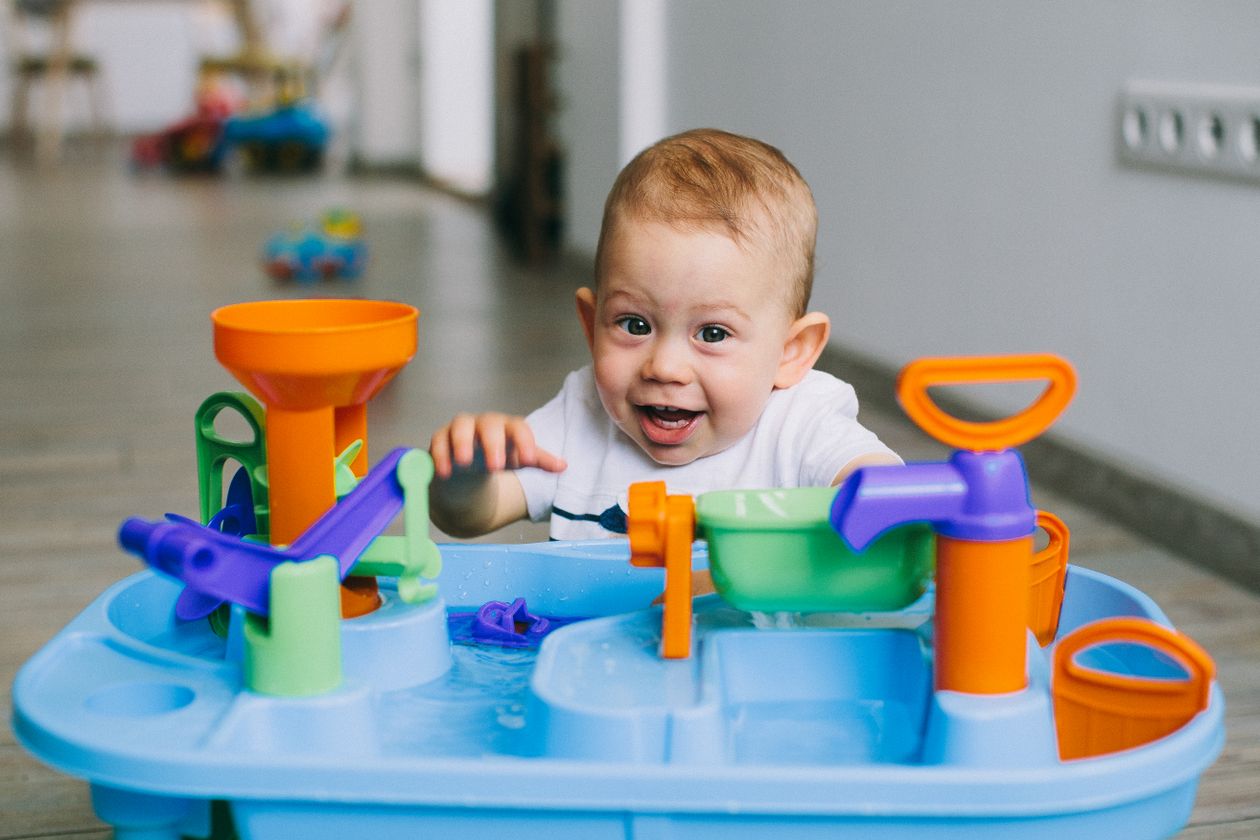
At 2, it’s almost all body and senses. Pouring, dumping, stacking, squishing, and dropping a spoon off the highchair for the ninth time to see if it lands the same way. That last one is a repeated trial, which is a real scientific move dressed up as a mess! Naming what’s happening out loud does more here than any instruction will, so narrate it and keep the materials coming.
At 4, the questions arrive and they get specific. Why is the moon out in the daytime? Where does the puddle go? A child this age can hold a prediction in their head, test it, and notice when they were wrong, and that loop is the engine under all of science. Give them a bowl of buttons and they’ll sort by size and color without being asked, then count the piles and announce which one wins. Four is also the age where a good question from you goes further than a good answer.
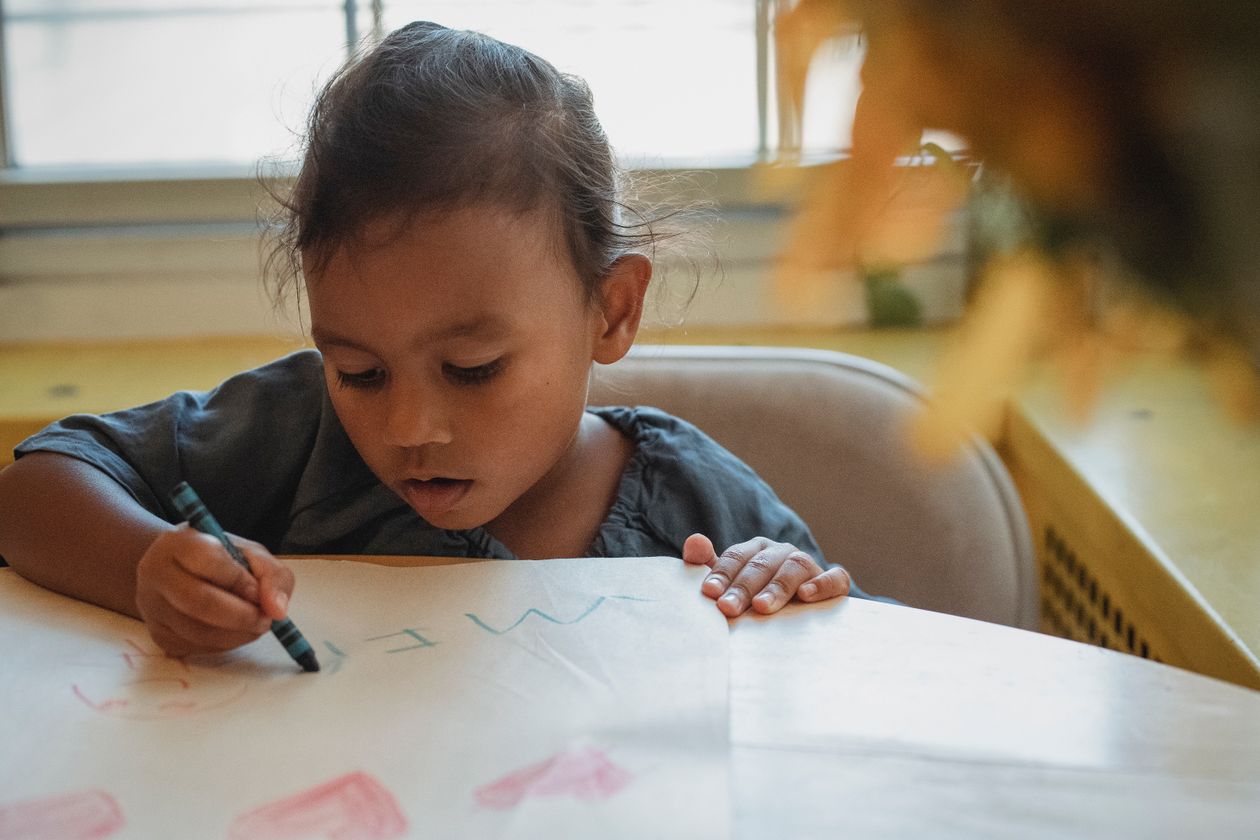
At 5, the thinking gets organized. A kid heading for kindergarten can plan a small investigation before starting it, remember what happened yesterday, and explain the whole thing to somebody else. They’ll want to record it too, usually in drawings with a lot of arrows!
There’s one thing that’s true at all three ages. Understanding builds by staying with the same ideas for weeks and months, which is the point the science teachers make most firmly, so coming back to the same materials does more than one big showy kit will. That holds in a classroom running on inquiry-based learning just as much as at your kitchen table.
See Early STEM in Action at a School Near You
A 2-year-old at the sink and a 5-year-old with a notebook both count as STEM because both of them are investigating something, and that thread is what our teachers pull on all day at Creative World School. It’s built into our 3 E’s, Education, Exploration, and Enrichment. Education is where mathematical and scientific thinking live, Exploration is the hands-on station work inside our Exploratorium™, and Enrichment is where a short investigation grows into a longer project. Find a school near you and come watch a room full of 3-year-olds take on a real question.

Related Articles
-
“Let’s Find Out” Is the Best STEM Answer You Can Give Your Preschooler
-
10 Creative Strategies for Introducing New Foods to Picky Toddlers: Tips and Tricks

-
10 Earth Day Adventures for Preschoolers
-
7 Fast Yet Nutritious Toddler Breakfasts for Busy Parents

-
Achieving Work-Life Balance with Young Kids: Practical Tips for Busy Parents

Categories
- About Creative World (3)
- All About Water (4)
- Altamonte Springs (1)
- Animal Adventures (4)
- Apollo Beach (6)
- Apopka (5)
- Art (5)
- Avalon (2)
- Avalon Park (5)
- Away We Go (3)
- Back to school (4)
- Belton (4)
- Blogs to Share on Social Media (7)
- Bonita Springs (1)
- Brandon (2)
- Brrr... Cold! (2)
- Buggin' Out (2)
- Build It Up Theme (6)
- CampTastic (3)
- Chesapeake (3)
- Childhood Development (33)
- Children Book Recommendations (14)
- Children Quotes (1)
- Children Songs (1)
- Construction Theme (1)
- Contests (1)
- Creative World Curriculum (4)
- Creative World School (2)
- Crosscreek (4)
- CW Activity (2)
- CW Books (11)
- CW Celebrates (11)
- CW Character Traits (1)
- CW Educational Focus (4)
- CW Spotlight (1)
- Cypress Springs (3)
- Delicious Recipes (2)
- Did You Know? (1)
- Down To Earth (3)
- Early Education (19)
- Education (7)
- Estero (8)
- Fall Activities (14)
- Fall Festival (1)
- Fishhawk (3)
- Food (2)
- Franchise (1)
- Franklin Township (4)
- Friendship Theme (1)
- Fun National Holidays (19)
- Georgetown, TX (4)
- Health & Safety (5)
- In The Sky (2)
- In The Trees (4)
- iSTEAM (6)
- Katy, TX (5)
- Kindergarten (5)
- Land O' Lakes (3)
- Leander, TX (1)
- Lee's Summit (5)
- Liberty (1)
- Literacy (8)
- Loudoun County, VA (2)
- Mealtimes (1)
- Naples (4)
- New Schools (3)
- North Naples (4)
- Oakstead (4)
- Ooey Gooey (1)
- Orlando (5)
- Our Staff Recommends (2)
- Outdoor Activities (14)
- Oviedo (4)
- Parenting (63)
- Parenting Advice (62)
- People We Know (3)
- psychology (1)
- Rivercrest (1)
- Riverview (5)
- RiverWalk (1)
- School Events (3)
- School Readiness (5)
- Sensory Play (2)
- social-emotional (3)
- Space Topic (1)
- Special Events (17)
- St. Cloud (2)
- St. Cloud (5)
- Starkey Ranch (5)
- STEAM (5)
- Summer (3)
- Summer Activities (38)
- Tampa (6)
- That's Me! (2)
- Tips (3)
- To The Grocery Store (2)
- Try this with your kids! (4)
- Tuition (1)
- TX (1)
- UCF (6)
- Uncategorized (72)
- Vinings (2)
- water (1)
- We're SERIOUS about PLAY (2)
- Week of the Young Child (2)
- Wesley Chapel (2)
- Winter Activities (3)