

Why Dry Nights Take Longer Than Dry Days
Creative world school Jul 24, 2026Your preschooler has been dry all day since last summer. Underwear at school, underwear at the park, not a single accident in months. And yet some mornings, the pull-up is soaked.
If you’ve been wondering what you missed, the answer is nothing. Staying dry overnight is a separate milestone from daytime potty training, and it runs on a clock inside your child’s body that neither of you gets to set. Some kids get there at three. Plenty don’t until six or seven, and they’re all completely normal. In the meantime, some of the standard advice helps and some of it just costs you sleep.
Daytime Potty Training and Nighttime Dryness Are Different Skills
Daytime training is something you can coach. Your child learns to notice the feeling, hold it for a minute, stop what they’re doing, and get to the bathroom. It works because your kiddo is awake for all of it. If you’re still in the middle of that stage, our calm and effective guide to potty training your toddler walks through the whole thing.
Nighttime is a different job, because your child is asleep. Nobody can practice a skill they’re unconscious for. The body has to handle it alone, and it will, once a few systems finish growing up. Did you know family history was the best timing prediction? If one parent wet the bed past age five, their child has about a 40% chance of doing the same, and when both parents did, it climbs to around 70%, according to the American Academy of Pediatrics. Ask your own parents whether they did the same. The answer can be such a relief!
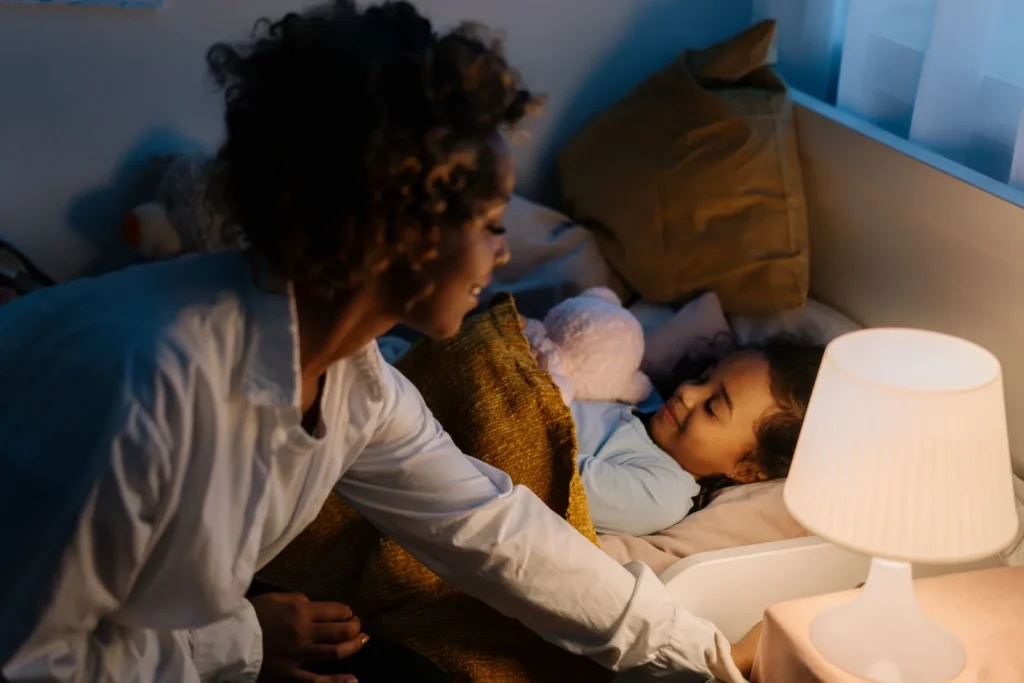
What Causes Bedwetting in Preschoolers, From Bladder Size to Hormones
Pediatricians point to three body systems that have to line up for a dry night, and a preschooler is usually waiting on at least one.
First, and most obviously, the bladder. Small children have small bladders, and overnight the body can make more urine than there’s room to store. Second, sleep. Preschoolers sleep hard, and the brain has to learn to catch the I’m-full signal and surface out of that. A kid who sleeps through the smoke detector chirping isn’t going to wake up for a bladder.
The third one surprises most parents. There’s a hormone that tells the kidneys to slow urine production overnight, which is why adults sleep eight hours without getting up. In young children that signal is still ramping up, and it arrives on its own schedule.
None of the three is a habit, and none of them responds well to reminders or rewards. They’re growth, the same way losing a first tooth is growth. About 15% of five-year-olds still wet the bed, the American Academy of Pediatrics reports, and by age 15 fewer than 1% do.
Why Waking Your Child to Pee Doesn’t Speed Things Up
The late-night lift is the first thing most families try. You carry a floppy, half-asleep kid to the toilet at ten, they pee with their eyes closed, and you carry them back. Some nights it buys you a dry bed. It doesn’t move the milestone, though, because a child peeing while barely conscious never makes the connection between a full bladder and waking up. The American Academy of Pediatrics suggests waking a child no more than once a night, since more than that cuts into the sleep they need.
Cutting off drinks after dinner is the other classic. On its own it rarely produces a dry morning, and it can leave a thirsty kid nervous about asking for water. The piece worth keeping is holding off on caffeine and salty snacks in the evening.
Reward charts deserve a mention too. A sticker for a dry night rewards a hormone rather than effort, and kids figure out fast that they can’t earn it. Save charts for things they can control.

Small Changes That Help With Bedwetting at Home
Start with constipation, the sneaky one. A backed-up bowel presses right on the bladder and shrinks how much it can hold, so more fiber and water during the day can change nights. Regular bathroom trips help too, along with one last stop before lights out.
Then make the laundry easier on yourself. Layer the bed with a waterproof cover, a sheet, a second waterproof cover, and a second sheet, so a 2 a.m. change takes about thirty seconds!
Most of all, keep your face and your voice neutral at 2 a.m. Let your child carry the wet sheets to the laundry room if they want to, as routine rather than consequence. In Dry Days, Wet Nights by Maribeth Boelts, Little Bear wants to stop wetting the bed, and his mother keeps steering him back to the idea that it happens when his body is ready. Reading it together hands your child language for something they can’t name yet.
When to Mention Bedwetting to Your Pediatrician
Wet nights are worth raising at the next well visit, and not much more than that. A few things deserve a call sooner. Tell your pediatrician if your child was dry overnight for six months or longer and then started wetting again, if peeing hurts, if the urine looks cloudy or unusual, if daytime accidents come back after they’d stopped, or if you notice a real change in mood, behavior, or the way your child walks.
It’s also fair to call because you’re worn out. Treatments exist for older kids, including bedwetting alarms that work for about half the children who use them properly, and your pediatrician can tell you when your child is old enough.
Growing up happens on a timeline your child sets, and what helps most is a place that meets them where they are. At Creative World School, our teachers guide inquiry-based learning at eye level, and our 3 E’s of Excellence™ curriculum gives every child room to explore, discover, and grow at their own pace in our Exploratorium™. Come see it in person and find a school near you!

Related Articles
-
“Let’s Find Out” Is the Best STEM Answer You Can Give Your Preschooler

-
10 Creative Strategies for Introducing New Foods to Picky Toddlers: Tips and Tricks

-
10 Earth Day Adventures for Preschoolers
-
7 Fast Yet Nutritious Toddler Breakfasts for Busy Parents

-
Achieving Work-Life Balance with Young Kids: Practical Tips for Busy Parents

Categories
- About Creative World (3)
- All About Water (4)
- Altamonte Springs (1)
- Animal Adventures (4)
- Apollo Beach (6)
- Apopka (5)
- Art (5)
- Avalon (2)
- Avalon Park (5)
- Away We Go (3)
- Back to school (4)
- Belton (4)
- Blogs to Share on Social Media (7)
- Bonita Springs (1)
- Brandon (3)
- Brrr... Cold! (2)
- Buggin' Out (2)
- Build It Up Theme (6)
- CampTastic (3)
- Chesapeake (3)
- Childhood Development (33)
- Children Book Recommendations (14)
- Children Quotes (1)
- Children Songs (1)
- Construction Theme (1)
- Contests (1)
- Creative World Curriculum (4)
- Creative World School (2)
- Crosscreek (4)
- CW Activity (2)
- CW Books (11)
- CW Celebrates (11)
- CW Character Traits (1)
- CW Educational Focus (4)
- CW Spotlight (1)
- Cypress Springs (3)
- Delicious Recipes (2)
- Did You Know? (1)
- Down To Earth (3)
- Early Education (19)
- Education (7)
- Estero (8)
- Fall Activities (21)
- Fall Festival (1)
- Fishhawk (4)
- Food (2)
- Franchise (1)
- Franklin Township (5)
- Friendship Theme (1)
- Fun National Holidays (19)
- Georgetown, TX (4)
- Health & Safety (5)
- In The Sky (2)
- In The Trees (4)
- iSTEAM (9)
- Katy, TX (5)
- Kindergarten (5)
- Land O' Lakes (3)
- Leander, TX (3)
- Lee's Summit (6)
- Liberty (1)
- Literacy (8)
- Loudoun County, VA (2)
- Mealtimes (1)
- Naples (4)
- New Schools (4)
- North Naples (4)
- Oakstead (5)
- Ooey Gooey (1)
- Orlando (5)
- Our Staff Recommends (2)
- Outdoor Activities (14)
- Oviedo (4)
- Parenting (67)
- Parenting Advice (70)
- People We Know (3)
- psychology (1)
- Rivercrest (1)
- Riverview (5)
- RiverWalk (1)
- School Events (3)
- School Readiness (5)
- Sensory Play (2)
- social-emotional (3)
- Space Topic (1)
- Special Events (17)
- St. Cloud (2)
- St. Cloud (5)
- Starkey Ranch (6)
- STEAM (5)
- Summer (3)
- Summer Activities (38)
- Tampa (7)
- That's Me! (2)
- Tips (3)
- To The Grocery Store (2)
- Try this with your kids! (4)
- Tuition (1)
- TX (1)
- UCF (6)
- Uncategorized (68)
- Vinings (2)
- water (1)
- We're SERIOUS about PLAY (2)
- Week of the Young Child (2)
- Wesley Chapel (2)
- Winter Activities (3)