

Making the Most of Your First Parent-Teacher Conference
Creative world school Nov 10, 2026Your first parent-teacher conference can bring on a little flutter of nerves. You’re about to sit across from the person who spends all day with your child, and part of you wonders what they’re going to say. Will it all be good news? Did your kid bite someone back in September?
Take a breath! A preschool conference is a warm, two-way talk about how your child is doing and growing. The teacher is on your team, and those few minutes together can be some of the most useful you’ll get all year. A little prep makes them even better.
What Happens at a Preschool Parent-Teacher Conference
At this age, the talk centers on the whole child more than on grades. Your child’s teacher will likely walk you through how your preschooler plays and gets along with other kids, how they handle big feelings and frustration, how their language and motor skills are coming along, and how they manage the routines of the day. Some teachers bring work samples or photos. Others share what they’re seeing day to day.
Every preschooler grows on their own timeline, so think of the conference as a snapshot of where your child is right now. If something surprises you, ask about it! Teachers expect questions, and that honest back-and-forth is the whole point.
There’s a good reason to lean in. Researchers Anne Henderson and Karen Mapp reviewed 51 studies and found that kids do better in school, with stronger attendance and behavior, when their families stay involved in their learning. A conference is one of the simplest ways to start that partnership early.

Questions to Ask Your Preschooler’s Teacher
In the moment, it’s easy to nod along and forget half of what you meant to ask. Jot down two or three questions ahead of time and bring them with you, so the conversation stays on what matters most to you.
Open questions work well. How does my child do when it’s time to share or take turns? Who do they look for at playtime? How do they handle it when something’s hard or doesn’t go their way? Is there anything worth practicing at home? Questions like these tend to bring back stories and examples, and those tell you a lot more than a quick “fine.”
It’s also fine to bring up the hard stuff. If bedtime’s a battle, screen time feels out of hand, or a behavior at home has you stumped, the teacher has probably seen it before and might have a simple idea to try.
If another grownup in your child’s life can’t make the meeting, ask whether they can join by phone. Either way, bring your notes home and share them, so everyone who cares for your child hears the same plan.
Tell the Teacher What You See at Home
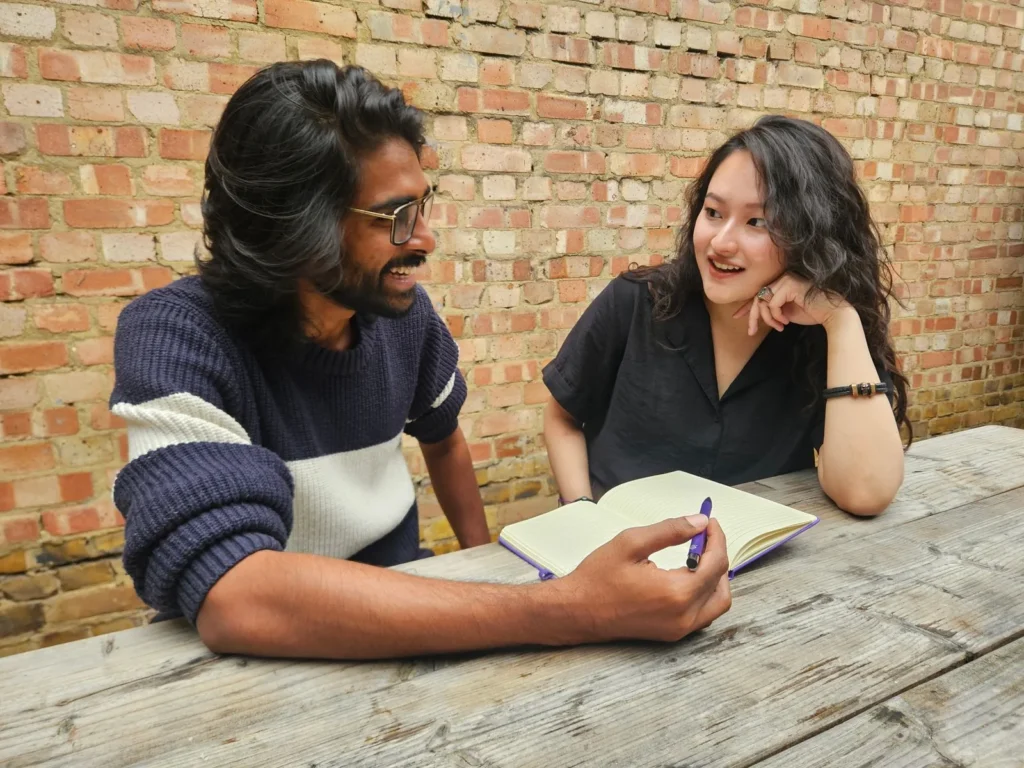
The conference works best when it goes both ways. You know your child in ways the classroom never sees, like the meltdown over the wrong color cup or the big fear of the vacuum. When you share what home looks like, the teacher gets a fuller picture and can meet your child right where they are.
Mention anything that might be shaping their days, like a rough drop-off, a recent move, a new baby, or a change in sleep. No detail is too small! Teachers use what you tell them to help the day feel safer and more familiar.
You can ask for ideas, too. If getting out the door in the morning is a daily struggle, ask how the teacher handles transitions in the classroom. When home and school use the same gentle approach, your child hears the same expectations in both places, and the hard moments tend to get easier.
It helps to remember that you and the teacher are building the same thing, a classroom where your child feels known and makes real friends. Read Our Class is a Family by Shannon Olsen with your preschooler the week of the conference. In Olsen’s story, a class becomes a second family where every kid belongs, mistakes are okay, and kindness counts, which gives your child easy words for the group they join every morning.
Make a Simple Plan for Home After the Conference
Before you leave, pick one or two things to focus on. Maybe your child is working on cutting with scissors, or learning to ask for help instead of melting down. Keep it small, because one thing you practice at home in a low-key way adds up over a few weeks. Write those one or two things down before you head home, since the details blur fast once the week gets busy.
Bring it up with your child in a positive way. Make it a game or a little project you tackle together, so it feels like play! Then check back with the teacher in a month or two with a quick note or a question at pickup, which keeps the two of you working on the same thing.
And celebrate the wins. If the teacher mentions your child has been kind to a new friend or finally nailed the cleanup song, let your kid know you heard about it. A little specific praise goes a long way.

Partnering With Families at Creative World School
At Creative World School, we think of families and teachers as one team. We track each child’s progress in a digital portfolio across every area of learning. Our hands-on Exploratorium™ includes Project iSTEAM, where inquiry, meaning your child’s own questions, comes first. Science, technology, engineering, art, and math grow out of those questions, so one “what if?” can turn into a song, a pattern, or a whole morning of predictions!

Related Articles


Categories
- About Creative World (2)
- All About Water (1)
- Altamonte Springs (1)
- Animal Adventures (2)
- Apollo Beach (6)
- Apopka (5)
- Art (3)
- Avalon Park (4)
- Back to school (4)
- Belton (4)
- Blogs to Share on Social Media (7)
- Brandon (3)
- Build It Up Theme (2)
- CampTastic (3)
- Chesapeake (3)
- Childhood Development (31)
- Children Book Recommendations (5)
- Construction Theme (1)
- Creative World Curriculum (2)
- Crosscreek (4)
- CW Activity (2)
- CW Books (2)
- CW Celebrates (3)
- CW Spotlight (1)
- Cypress Springs (4)
- Did You Know? (1)
- Down To Earth (1)
- Early Education (4)
- Education (1)
- Estero (2)
- Fall Activities (22)
- Fall Festival (1)
- Fishhawk (4)
- Food (1)
- Franchise (1)
- Franklin Township (5)
- Friendship Theme (1)
- Fun National Holidays (19)
- Georgetown, TX (4)
- Health & Safety (4)
- In The Sky (2)
- iSTEAM (9)
- Katy, TX (5)
- Kindergarten (5)
- Land O' Lakes (3)
- Leander, TX (3)
- Lee's Summit (6)
- Liberty (1)
- Literacy (5)
- Loudoun County, VA (2)
- Naples (4)
- New Schools (4)
- North Naples (4)
- Oakstead (5)
- Ooey Gooey (1)
- Orlando (5)
- Outdoor Activities (14)
- Oviedo (4)
- Parenting (53)
- Parenting Advice (62)
- psychology (1)
- Riverview (5)
- RiverWalk (1)
- School Events (3)
- School Readiness (4)
- Sensory Play (1)
- social-emotional (2)
- Space Topic (1)
- Special Events (14)
- St. Cloud (2)
- St. Cloud (5)
- Starkey Ranch (6)
- STEAM (1)
- Summer Activities (35)
- Tampa (7)
- That's Me! (1)
- Tips (2)
- To The Grocery Store (1)
- Try this with your kids! (2)
- Tuition (1)
- TX (1)
- UCF (6)
- Uncategorized (62)
- Vinings (2)
- We're SERIOUS about PLAY (2)
- Week of the Young Child (1)
- Wesley Chapel (3)
- Winter Activities (1)